# First-time exhibitor in Saudi Arabia: a step-by-step guide
> A first time exhibitor guide for Saudi Arabia: choose the show and space, design, approve and build your exhibition stand, then run the show and follow up.
Source: https://bilievent.com/articles/first-time-exhibitor-guide-saudi-arabia/ · bilievent · 2026-11-13
This first-time exhibitor guide for Saudi Arabia comes down to six stages: set the objective and budget, choose the show and the space, design and approve your exhibition stand, build and install it, run the show days, and follow up afterwards. Exhibitors who plan these stages backwards from the show date arrive ready; those who start with the design before the objective usually pay more and get less.
Think of this article as a roadmap for your company’s first trade show in the Kingdom. For each step we explain the decision you need to make and who makes it, and we point you to the detailed guide on our site. We use the names buyers actually search for: exhibition stand, exhibition booth or trade show booth, which all describe the same thing on the show floor.
## Key takeaways
- Start with one measurable objective; it decides the show, the space and the stand design.
- Your space type (shell scheme or space only) changes everything that follows, so confirm it with the organiser before any design work.
- The organiser’s exhibitor manual is the reference for every deadline and rule, so request it as soon as you book.
- Plan backwards from the first build-up day: drawing approval, fabrication, then transport and installation.
- Exhibiting does not end at closing time: following up with visitors and storing your stand are part of the return on the investment.
## How to exhibit at a trade show: from objective to booking
### Set your objective and full budget
Before asking what a stand costs, ask why you are exhibiting. Launching a product, meeting distributors, collecting qualified leads and building brand presence in one sector each lead to different decisions on space size, layout and team. Then write a budget for the whole participation, not just the stand: the organiser’s space fee, stand design and build, printed graphics, freight, travel and accommodation for the team, and samples or giveaways. Our [exhibition booth cost guide](https://bilievent.com/guides/exhibition-booth-cost-saudi-arabia/) explains what pushes the cost up or down.
### Choose the right show
Saudi Arabia hosts a large number of trade shows across many sectors, and the right one for you is not necessarily the biggest; it is the one your buyers attend. Use our [Saudi exhibitions calendar](https://bilievent.com/saudi-exhibitions-calendar/) to see upcoming shows by sector, city and date, then study each show’s official website: who exhibits, who visits and what the organiser says about previous editions.
### Book the space and ask for the exhibitor manual
When you book, ask the organiser where your space sits on the floor plan, whether it is shell scheme or space only, the maximum stand height and the design approval rules. Request the exhibitor manual straight away: it sets the drawing submission deadline, the build-up and breakdown days, and the rules on power and materials. If your country runs a national pavilion at the show, compare it with a stand of your own first; our guide to exhibiting in a [country pavilion at a Saudi trade show](https://bilievent.com/articles/country-pavilion-saudi-trade-shows/) explains what the pavilion organiser covers.
## Choosing your space and exhibition booth type
Most shows offer two kinds of space. A shell scheme comes with a basic structure from the organiser (walls, a fascia name board and simple lighting) that you upgrade with graphics, furniture and display units. Space only is bare floor on which an approved contractor builds a full custom stand. For first time exhibitors a shell scheme is usually simpler and faster, while a custom stand gives you more freedom in branding and layout. Our guide to [shell scheme vs custom booth](https://bilievent.com/guides/shell-scheme-vs-custom-booth/) compares the two in detail.
There is a third option many first-timers overlook: renting a ready-designed stand and branding it as your own, which suits companies that do not expect to exhibit again soon. Whichever route you take, our [exhibition booth design and production](https://bilievent.com/booth-production/) service keeps design, fabrication and installation with one team.
## Design and approval: what to prepare before the designer starts
Good stand design starts with a clear brief from the exhibitor. Before the first meeting, prepare the space dimensions and its position on the floor plan, your objective, the products you will display and their sizes, the number of staff, whether you need a meeting room or a storage cupboard, and your brand files and logo. Our guide on [what to send your booth contractor](https://bilievent.com/guides/what-to-send-your-booth-contractor/) gives the full checklist.
After the first concept come revisions, then the technical drawings that your contractor submits to the organiser for approval when the space is space only. Do not treat the design as final before the organiser approves it, because they may ask you to change the height, the materials or the emergency exits. If the exhibitor manual uses terms such as space only or shell scheme, our [exhibition terms glossary](https://bilievent.com/articles/exhibition-terms-glossary/) explains them in English and Arabic.
## Production and installation: plan backwards from build-up
The most important rule for a first-time exhibitor: do not plan forward from today, plan backwards from the first build-up day in the exhibitor manual. Before build-up comes transport, before that the end of fabrication, before that the start of fabrication after approval, and before that the drawing submission deadline. Our [booth production timeline guide](https://bilievent.com/guides/booth-production-timeline/) explains what makes each stage longer or shorter.
During build-up the contractor’s crew installs the stand, runs the power and lighting and checks everything before opening. You need one person on site to receive the stand and check the graphics, lighting and product positions. Our guide to [exhibition stand build-up and dismantling in Saudi Arabia](https://bilievent.com/articles/exhibition-stand-build-up-dismantling-saudi-arabia/) explains what happens on those days.
## The stages at a glance
|
Stage |
Key decision |
Who decides |
|
1. Objective and budget |
Why we exhibit and what we spend in total |
Management and marketing |
|
2. Choosing the show |
Which show our target buyers attend |
Marketing and sales |
|
3. Booking the space |
Size, position and space type |
Exhibitor with the organiser |
|
4. Design and approval |
Layout, branding and materials |
Exhibitor with the designer, then the organiser |
|
5. Production and installation |
Fabrication, freight and build-up |
Contractor, supervised by the exhibitor |
|
6. Show days |
Team, shifts and lead capture |
Exhibitor |
|
7. After the show |
Follow-up, storage and review |
Exhibitor and contractor |
## Your stand team and the show days
A good-looking stand does not sell on its own; the team turns visits into opportunities. Before the show, decide who staffs the stand in each shift, who can talk about prices, and who looks after key visitors. Train the team to open with a short question rather than waiting behind the counter, and agree on one way to record interested visitors’ details with their consent.
- Prepare consistent talking points about your company and product in three sentences.
- Plan shifts that allow breaks without leaving the stand empty.
- Keep a small stock of brochures and samples inside the stand, away from the aisle.
- At the end of each day, review what worked and what to change tomorrow.
### The show kit: what stays inside the stand
First-timers often forget the small things that stop work in the middle of a busy day. Keep a closed box inside the stand with chargers and approved extension leads, spare copies of your printed material, business cards, simple cleaning supplies for surfaces and screens, tape and light fixings, a printed copy of the exhibitor manual, and the phone numbers of the organiser and your stand builder. Agree with your contractor on who to call if a light fails or a panel comes loose during the show.
## After the show: follow-up and storage
The real value of exhibiting shows up in the weeks after the event. Contact interested visitors quickly while they still remember your conversation, and compare the results with the objective you set at the start: how many qualified visitors you recorded, how many meetings became quotations, and what you would change next time in space, design or team. That short review is what makes your second show clearer and cheaper than your first.
Do not treat the stand itself as disposable. Flooring, display units, lighting and structures can often be stored and reused with updated graphics, as our guide to [exhibition stand storage and reuse in Saudi Arabia](https://bilievent.com/articles/exhibition-stand-storage-reuse-saudi-arabia/) explains.
## First-time exhibitor mistakes and how to avoid them
- **Designing before deciding the objective:** a beautiful stand that serves no clear goal. Write the objective first and let the design follow it.
- **Ignoring the exhibitor manual:** most build-up surprises are written in it. Read it in full and pass it to your contractor.
- **Budgeting for the stand only:** freight, travel, graphics and the organiser’s service charges add up. Budget for the whole participation.
- **Showing every product:** crowded shelves blur the message. Choose what serves this show’s objective.
- **An unprepared team:** staff who do not know what to say or how to record a visitor’s details. Train them before opening day.
- **No plan after closing:** leads with no follow-up and a stand dismantled with nowhere to go. Plan the after-show from the start.
## How bilievent supports first-time exhibitors
At bilievent we design exhibition stands and prepare the approval drawings, fabricate them in our own 400 m² workshop in Al Sulay, Riyadh, install them at the venue and dismantle them after closing. Because fabrication happens in our own workshop rather than with a third party, one team follows your stand from the first sketch to build-up day, which is what a first-time exhibitor needs when it is not yet clear who to ask about each detail. We store reusable stand elements for your next show and also offer exhibition stand rental. We work inside Saudi Arabia only, in Riyadh, Jeddah and the Makkah region, the Eastern Province and the rest of the Kingdom, and our office in Al Yasmin, Riyadh, receives clients from Sunday to Thursday.
If this is your first show and you want a plan that fits its dates, send us the show name and your space size and type through our [request page](https://bilievent.com/request/), and we will come back with clear steps and a schedule worked back from build-up day.
Frequently asked questions · bilievent
Use this infographic on your site
Copy the code below to show this infographic on your site; please keep the credit link.
Source: bilievent
## Frequently asked questions
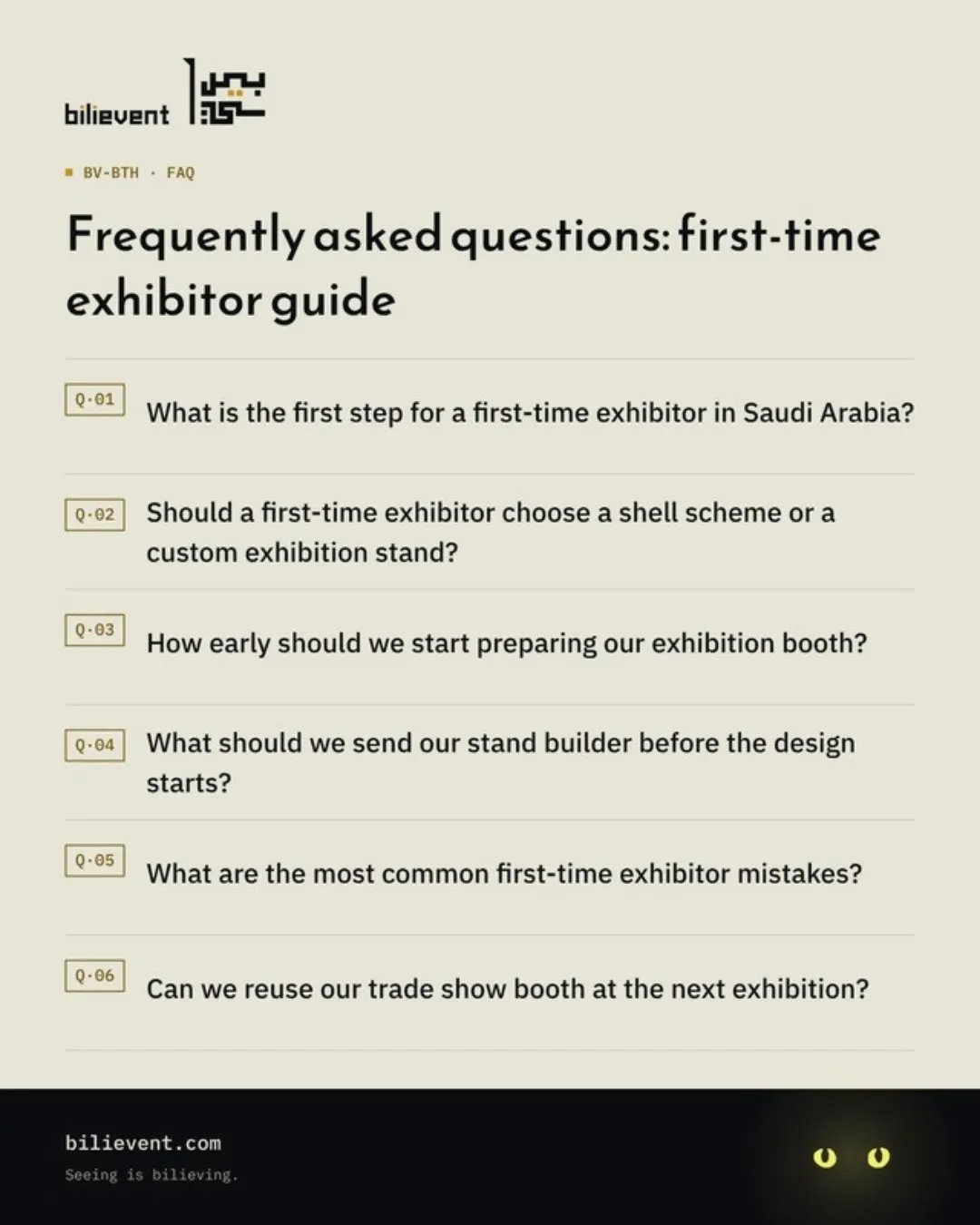
### What is the first step for a first-time exhibitor in Saudi Arabia?
Start by setting one measurable objective, such as meeting a number of distributors or collecting qualified leads, then write a full budget that covers the space, the stand, freight, travel and printed material. Next, choose the show your target buyers attend, book the space and request the exhibitor manual from the organiser.
### Should a first-time exhibitor choose a shell scheme or a custom exhibition stand?
A shell scheme is simpler and faster for a first show because the organiser supplies a basic structure that you upgrade with graphics and furniture. A custom stand on space only gives more freedom in branding and layout but needs design, organiser approval and fabrication. Renting a stand is a third option if you do not expect to exhibit again soon.
### How early should we start preparing our exhibition booth?
Start from the first build-up day in the exhibitor manual and work backwards: transport, end of fabrication, start of fabrication after organiser approval, then the drawing submission deadline. The real time depends on stand size, materials and how quickly the design is approved, so request the manual as soon as you book and start your brief early.
### What should we send our stand builder before the design starts?
Send the space dimensions and its position on the floor plan, whether it is shell scheme or space only, your objective, the products you will show and their sizes, the number of staff, any need for a meeting room or storage, your brand files and logo, and the exhibitor manual if you have it. A clear brief brings the first design closer to the final one.
### What are the most common first-time exhibitor mistakes?
The most common are designing before setting the objective, ignoring the exhibitor manual and its deadlines, budgeting for the stand alone without freight, travel and services, crowding the stand with too many products, sending an untrained team, and having no plan after closing for following up leads and storing the stand for reuse.
### Can we reuse our trade show booth at the next exhibition?
Yes. Many elements such as flooring, display units, lighting and structures can be stored and reused with updated graphics that fit the new space. Design the stand from the start with modular parts that can be taken apart and adapted, and agree storage with your contractor after the show; this lowers the cost of your next participation.