# Pop-up store in Saudi Arabia: from idea to opening day
> Planning a pop-up store in Saudi Arabia? Choose the location and length, plan the fit-out, stock and point of sale, and check approvals before opening.
Source: https://bilievent.com/articles/pop-up-store-saudi-arabia/ · bilievent · 2026-11-14
A pop-up store in Saudi Arabia is a temporary shop that a brand opens for a few days or weeks in a mall, at an event or during a season, and it is one of the clearest forms of pop-up activation: a small space designed for people to try the product, buy it and meet the brand face to face. It works when it is planned as a short project with a clear goal and a fixed opening date, not as a temporary front put together at the last minute.
This guide explains when a pop-up store is the right choice and when a simpler pop-up booth will do, how to choose the location and the length of the run, what the design, fit-out, stock and point of sale involve, what to ask the venue and the relevant authorities before you open, and the mistakes that most often delay an opening or weaken the result.
## Key takeaways
- A pop-up store is a temporary project with one clear goal: a product launch, a market or city test, seasonal sales or building a customer base.
- The location decides everything after it, because the mall’s or the event’s rules set the footprint, height, materials and build-up times.
- A modular design shortens installation and lets you move the same store to a second site or store it for the next season.
- Point of sale, stock and daily operation are planned before the design, because they set the storage, the counter and the power.
- Venue approvals and the requirements for selling are checked early with the venue and the relevant authorities, never assumed.
## What a pop-up store is and when it fits
A pop-up store is a temporary space for selling and for experiencing a product. It is not the same as a trade show, which gathers many exhibitors in a hall for a fixed number of days, and it is not the same as an activation booth, which usually focuses on the experience and on collecting leads more than on sales. So the first question is: should the space sell, introduce the product, or do both? When the goal is trial rather than sales, a [sampling booth in Saudi Arabia](https://bilievent.com/articles/sampling-booth-saudi-arabia/) is often the simpler format to plan first.
A pop-up store makes sense in a few clear situations:
- **Launching a product or a new collection:** you want people to see, touch and try it before it reaches shops, or alongside the online launch.
- **An online brand that wants a physical presence:** a temporary shop lets customers see the product and builds trust before you commit to a permanent branch.
- **Testing a city or district:** before you rent a permanent unit in a new city, you test demand for a few weeks in a busy location.
- **Seasonal selling:** seasons, holidays and major events bring crowds that do not come back the rest of the year.
If your goal is to collect leads or hand out samples over a day or two, a simpler pop-up booth with no point of sale and no stock may be enough. Our guide to the [mall pop-up booth in Saudi Arabia](https://bilievent.com/articles/mall-pop-up-booth-saudi-arabia/) covers that option in detail, and our [pop-up activations](https://bilievent.com/pop-up-activation/) page shows what we build for brands in both cases.
## Choosing the location and how long to stay
Location is a business decision before it is a design decision. Start with where your customers actually are during the period you have in mind, then compare the options against these criteria:
|
Type of site |
What it suits |
What to ask before you book |
|
A mall aisle or atrium |
Selling and trial with shoppers who pass every day |
The footprint available, height limits, night build-up times, and the rules on materials, lighting and power |
|
An event or a season |
A large audience over a short period, with the energy of the event |
The organiser’s requirements, the handover date, what you may sell and the opening hours |
|
An empty shop on a short lease |
An experience closer to a real store, with more space |
The condition of the unit, the licences the activity needs, the lease term and what must be returned as found |
|
A stand at a trade show |
Direct sales or order-taking with a specialist audience |
The show’s rules on selling in the halls, the exhibitor manual and the build-up and dismantling dates |
The length of the run depends on your goals and budget: a few days suits a launch tied to an event, and a few weeks suits market testing and seasonal selling. There is no single right length, but count the build-up and dismantling days as part of the booking, and remember that a store open for weeks needs daily operation, restocking and small repairs, not just an opening.
## Design and fit-out
A successful pop-up store design reads simply and clearly from a distance: the logo and the hero product are visible from the aisle, the visitor then steps into the trial area, and then reaches the counter.
### Modular construction
Building the store from units that assemble and take apart shortens installation in a mall, where working hours are often short and at night, and lets you move the same store to a second site or keep it for the next season. Our guide to [exhibition stand storage and reuse](https://bilievent.com/articles/exhibition-stand-storage-reuse-saudi-arabia/) explains how to work out whether storing beats building again.
### Lighting and graphics
Lighting on the product matters more than the general light of the venue, especially inside malls. Graphics such as panels, floor stickers, unit wraps, price cards and wayfinding signs should be ordered with the design, not after it; our [event branding](https://bilievent.com/event-branding/) service covers what can be produced alongside the build.
### Hidden storage
A temporary shop sells from stock kept close by. Build lockable cupboards into the units for products, bags and packaging, so the display table does not turn into a warehouse.
## Stock and point of sale
Before the design is final, answer these questions, because they change the dimensions and the power plan:
- How many products will you display, and how many will you sell from the store itself?
- Where is the extra stock kept, and who restocks the shelves and when?
- What point-of-sale and payment devices do you need, where do they go, and do they need steady power and internet?
- Will you sell on the spot or take orders for delivery only, and how are orders and customer details recorded?
- Who staffs the store, on what shifts, and where does the team rest out of sight of visitors?
If you will sell, check with your accountant that the temporary point of sale meets your company’s existing VAT and e-invoicing obligations; the current requirements are published by the [Zakat, Tax and Customs Authority](https://zatca.gov.sa/en/Pages/default.aspx).
## Marketing before and after opening
A temporary store cannot wait for visitors to discover it. Announce the dates and the location on your channels before opening, and give people a reason to come: a product shown for the first time, an experience not available online, or a limited quantity. While the store is open, collect the details of interested visitors with their consent, because the value of a pop-up store carries on after it closes if you follow up with those customers. After closing, compare the result with the goal you started with: sales, customer data, or evidence that the city deserves a permanent branch.
## A checklist for the week before opening
The last week before opening fills up with small details that delay day one if nobody settles them. Go through this list with your team and your contractor:
- The design is approved in writing by the mall management or the organiser, and you have a copy with you on build-up day.
- Build-up and dismantling times are confirmed to the hour, with the entrance for the units and the person escorting the crew agreed.
- The power order is submitted and confirmed, and the counter and point-of-sale positions are marked on the plan.
- Graphics, price cards and wayfinding signs are printed and proofread in Arabic and English.
- The first stock is in place, with a clear restocking plan for the first two days.
- The team rota is written down, and every staff member knows what to say about the product and how to record interested visitors.
- There is a contact for quick repairs during the run, because a failed light or a loose panel should be fixed in hours, not days.
## Venue approvals and the relevant authorities
Every venue has its own rules, so never assume that what one mall allowed another will allow too. Before the design starts, ask the mall management or the event organiser for the permitted footprint and height, accepted materials and fire-rating requirements, build-up and dismantling times, power and rigging rules, and how the design is approved. If the store will sell, check with the relevant authorities what registration and licences your activity needs, because requirements vary with the activity and the location and can change; confirm them at the time rather than relying on a previous experience.
## Common mistakes and how to avoid them
- **Designing before you have the venue rules:** a store that exceeds the height limit or uses unaccepted materials gets redesigned at the last minute. Ask for the rules first.
- **Forgetting storage:** without hidden cupboards, cartons fill the space within a day.
- **A point of sale with no steady power or internet:** slow payments lose sales, so fix the counter position and power early.
- **A build that cannot move:** a store built for one site is hard to move or store, so you pay the full build cost a second time.
- **No operating plan:** opening day is not the finish line; staff, shifts, restocking and daily cleaning are part of the project.
- **No measurable goal:** if you do not decide what to measure before opening, you will not know afterwards whether the store worked.
## How bilievent builds pop-up stores
At bilievent we design pop-up stores and brand activation booths, prepare the drawings for venue approval, and fabricate them in our own 400 m² workshop in Al Sulay, Riyadh, delivering inside Saudi Arabia: Riyadh, Jeddah and the Makkah region, the Eastern Province and the other regions. In our Al Sulay workshop we assemble and test the units, the counter and the lighting before they travel, so installation in the mall or at the event means putting together what has already been tested, not building on site. We store reusable elements for your next season, offer exhibition stand rental when you need a temporary solution, and print the store’s graphics and panels. For agencies we work under NDAs and deliver white-label. If you are weighing renting against building, read our guide to [exhibition stand rental in Saudi Arabia](https://bilievent.com/articles/exhibition-stand-rental-saudi-arabia/). If a portable backdrop is all the space needs, our [pop up stand guide](https://bilievent.com/articles/pop-up-stand-exhibitions/) explains when it beats a built unit.
If you have a site or an opening date in mind, send us the footprint, the venue rules and what you plan to show and sell, or [request a quote](https://bilievent.com/request/), and we will come back with a plan that fits the time left before opening.
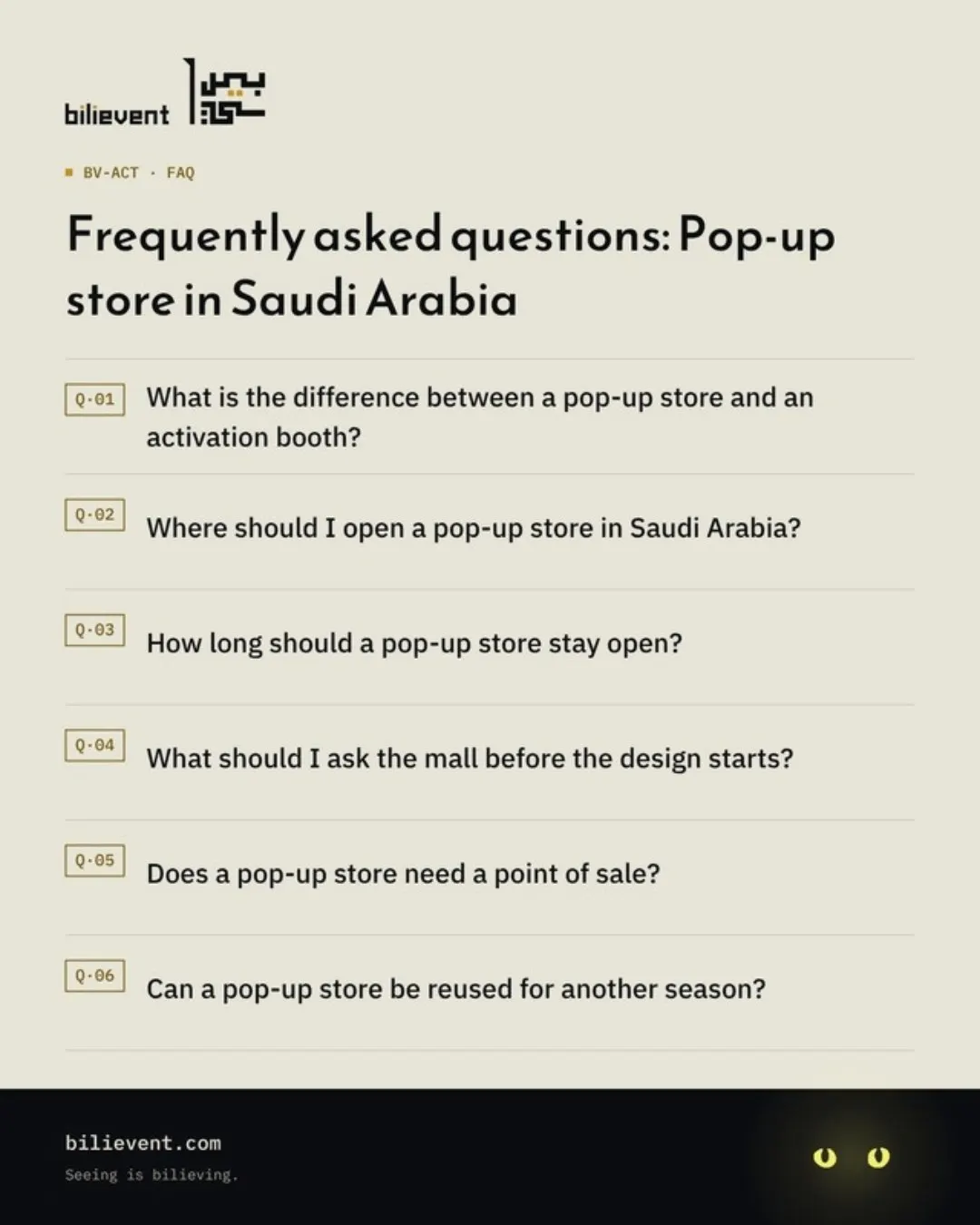
Frequently asked questions · bilievent
Use this infographic on your site
Copy the code below into your page, and please keep the credit link.
Source: bilievent
## Frequently asked questions
### What is the difference between a pop-up store and an activation booth?
A pop-up store is a temporary space whose main purpose is selling and trial together, so it usually needs stock, a point of sale and a team working in shifts. An activation booth usually focuses on product trial, collecting leads or sampling over a short period, and does not have to sell. Decide your goal first, then pick the format that serves it with the least complexity.
### Where should I open a pop-up store in Saudi Arabia?
Open it where your customers are during the period you have in mind: a mall aisle or atrium for daily selling, an event or season for a large crowd over a short time, or an empty shop on a short lease for an experience closer to a real store. Before booking, ask about the footprint, height, build-up times and the rules on materials and power.
### How long should a pop-up store stay open?
There is no single right length. A few days suits a launch tied to an event, while a few weeks suits testing a city or seasonal selling. Count the build-up and dismantling days in the booking, and remember that a store open for weeks needs daily operation, restocking and small repairs, so tie the length to your goal and to the budget for running it, not only for building it.
### What should I ask the mall before the design starts?
Ask for the permitted footprint and height, accepted materials and fire-rating requirements, build-up and dismantling times, which are often at night, the power and rigging rules, and how and when the design is approved. If you will sell, ask about the selling conditions on site, and check with the relevant authorities what registration and licences your activity needs before opening.
### Does a pop-up store need a point of sale?
If the store will sell on the spot, yes: you need a counter in a fixed position, steady power and internet, and payment devices. If you only take orders for delivery, a system to record orders and customer details is enough. In both cases, confirm with your accountant that temporary selling meets your company’s existing VAT and e-invoicing obligations.
### Can a pop-up store be reused for another season?
Yes, if it is built from modular units that assemble and take apart. That kind of design shortens installation on site and lets you move the same store to another mall or event, or store its elements for the next season and change only the graphics. A store built for a single site is hard to move, and you often end up paying the full build cost a second time.