
Exhibition stand build-up and dismantling are the days when an approved design becomes a standing booth in the hall, and then goes back to the workshop or the warehouse after the show. What happens on those few days decides whether you open calmly on time or spend the first morning fixing what was missed.
This guide walks through build-up and breakdown at Saudi exhibitions step by step, whether you call it an exhibition stand, an exhibition booth or simply your stand: what has to be approved before build-up day, how the stand travels from the workshop to the venue, what happens in the hall until doors open, and how dismantling, space handover and storage work. It ends with the mistakes exhibitors make most often on build days and how to avoid them.
Key takeaways
- The organiser sets build-up and dismantling times in the exhibitor manual, so plan every step backwards from those dates, not from opening day.
- Drawing approval, the power order and contractor registration all happen before build-up; a delay in any of them can stop work in the hall.
- A smooth build starts in the workshop: a trial assembly before shipping catches problems while they are still easy to fix.
- The final check before opening needs someone from your team on site, not only the stand builder.
- Dismantling has a hard deadline for handing the space back clean, so decide before the show what returns to storage and what is disposed of.
Before build-up day: what must be approved
Build-up days are short and crowded, and there is no room in them for decisions nobody has made yet. Most of the work is settled weeks before, and part of it sits with the exhibitor rather than the contractor. Start with the exhibitor manual the organiser sends after you book your space. It lists build-up and breakdown times, deadlines for submitting drawings, height and rigging rules, and how to order services. Exhibitors inside a national pavilion also follow the pavilion organiser’s schedule, as our guide to the country pavilion at a Saudi trade show explains.
The items that need to be approved or ordered before build-up:
- Stand drawings: most organisers ask for plans showing dimensions, heights and materials before they allow construction, especially for space-only plots. Your stand builder usually prepares them, but you should track the submission date and make sure written approval comes back.
- Power and services: electricity, and sometimes water, compressed air or internet, are ordered from the organiser or its official contractor by a set date. At many shows a late order costs more or is simply not available. Our guide to power, rigging and design approval for space-only stands covers this in detail.
- Contractor registration: many organisers require the stand contractor to register and to request passes for its crew, and some ask for a method statement, a risk assessment and an insurance certificate. Ask your builder which documents it prepares and which ones need your signature.
- Graphic files: final sizes come from the builder, and printing happens before the stand ships. Reprinting on build-up day is rarely possible. Our guide to event graphics materials and installation methods explains the options.
- Exhibits and freight: if you are bringing heavy products, machines or your own screens, agree when they arrive and how they enter the hall so they fit the build sequence.
One practical habit helps more than any other: put every one of these dates into a single schedule shared by your team and the builder, with one named owner per line. Most build-day problems come from each side assuming the other had it covered, and a shared list with names and dates removes that doubt before anyone reaches the hall. To keep your team, the contractor and the organiser using the same words, keep our exhibition terms glossary to hand.
Transport from the workshop to the hall
A good build-up starts before the stand leaves the workshop. For a custom stand, the structure, walls, counters and display units are made in the builder’s workshop, and ideally the stand, or at least its main sections, is assembled once as a trial before packing. A trial assembly reveals size differences, missing parts and finishing defects at the point where they are fastest to fix. You can see how we approach this on our exhibition booth design and production page.
The stand is then taken apart, wrapped and labelled in build order, so what goes up first is loaded last and comes off the truck first. Venues usually control truck access, unloading times and loading bays, and some shows give each contractor a time slot for vehicles. Transport is planned around the organiser’s instructions, not only around the builder’s convenience.
For shows outside Riyadh, in Jeddah or the Eastern Province for example, travel time is part of the plan, and the crew carries tools and spare parts so a missing fixing does not stop the build.
What the exhibitor decides at this stage: who receives exhibits that arrive through a freight forwarder, whether products need a temporary holding place before they go on the stand, and who carries the passes and documents that venue security may ask for at the gate.
Installation in the hall, step by step
The exact order depends on the design, but building a custom exhibition booth on site usually follows these stages:
- Taking over the space: the crew checks the plot boundaries and number against the organiser’s floor plan and confirms where the power point is before anything is placed.
- Floor or platform: a raised floor goes down first if the design has one, with cable routes underneath, then the finished surface.
- Structure and walls: frames, walls and ceilings go up, plus any hanging elements if rigging has been approved.
- Electrics and lighting: the builder’s team installs the internal wiring and fixtures, while at many venues the organiser’s official contractor connects the main supply.
- Graphics and finishing: printed panels are fitted, joints and edges are finished, and protective films come off last.
- Furniture, screens and displays: everything is placed and the screens and media players are tested.
- Cleaning: dust and offcuts are cleared before your team starts setting out products.
Your role during these days is to have one person who can be reached at any time and can make the small decisions that cannot wait: where a screen goes, how a product is placed, a minor change to a logo position. Merchandising the stand normally starts once the heavy work is finished and the space is clean, so products are not exposed to dust or scratches.
The table below summarises who does what at each stage:
| Stage | What happens | What the exhibitor decides or provides |
|---|---|---|
| Before build-up | Drawing approval, service orders, crew registration | Deadlines, signatures, final graphic files |
| Transport | Packing, labelling and loading to venue time slots | Receiving freighted exhibits, required documents |
| Installation | Platform, structure, electrics, graphics, furniture | A decision-maker available on site |
| Final check | Snag list, fixes, lighting and screen tests | Sign-off, then merchandising |
| Show days | Technical support when needed | Reporting any fault straight away |
| Dismantling | Exhibits out, stand down, space handed back | What is stored and what is disposed of |
Final check before opening
Before doors open, walk the stand together: someone from your team and the builder’s site lead. The aim is a clear written snag list, with every item fixed before opening rather than during the first visitors’ hour. Check:
- That the stand matches the approved design: colours, logos, text and dimensions.
- Lighting: every fixture works and the light falls on the products and messages that matter most.
- Screens and devices: the right content plays, sound levels follow the show rules, and remotes or controls are where your team can reach them.
- Safety: no exposed cables or sharp edges, shelves and tall elements are stable, and people can move freely inside the stand.
- The storage room, if there is one: it locks properly and has space for brochures and supplies.
- Cleanliness: floor, glass and surfaces, with any leftover labels or wrapping removed.
Some organisers also inspect stands before opening to check heights and safety rules, so aim to be ready before that walk-round, not as it arrives.
Support during show days
The builder’s job does not end when the stand is up. During the show a light can fail, a graphic panel can lift, or a shelf can need extra fixing after heavy use. Agree in advance how these calls work: who you phone, how long a technician needs to reach the hall, and what gets fixed immediately versus after closing. Keep a small kit on the stand with double-sided tape, scissors and rubbish bags.
Exhibitors often forget that visitors are admitted at a set time, but exhibitor staff may be allowed in earlier each morning, at a time the organiser sets. Use that window for a quick clean, restocking and switching on screens, not for repairs that belonged to build-up day.
Dismantling, handover and exhibition stand storage
Breakdown starts after the official close of the last show day, and many organisers do not allow anything to be removed before then. The safe order is for your team to take out valuable exhibits, devices and documents first, and only then for the builder’s crew to start dismantling. The first hours after closing are when the hall is most crowded with crews and trolleys, and when loss and damage are most likely.
After dismantling, the space has to be returned as it was received, with no waste and no tape residue on the floor. The organiser sets a final deadline for clearing the hall and may charge for waste left behind or damage to the floor. Ask your builder directly whether its quote includes dismantling, waste removal and space handover.
This is also where a decision is best made before the show, not after it: what is disposed of and what goes back to the warehouse. Stand storage and reuse means designing some elements from the start to be taken down, stored and rebuilt, such as counters, display units, frames and lighting, while graphics are usually replaced for each show. If you return to the same shows every year, a reusable exhibition stand can save part of the fabrication cost next time. When your booth goes into storage, ask for an inventory with photos of each element’s condition, so you know before the next show what can be used and what needs repair.
Common mistakes on build days and how to avoid them
- Planning from opening day: the dates that matter are the drawing deadline, the service order deadline and the start of build-up. Work back from them.
- Ordering power late: a stand without electricity on the first morning loses the busiest hours. Order on time and keep the confirmation.
- Approving graphics at the last minute: any error in a print file becomes a visible error on the wall. Sign off files at the builder’s sizes well before shipping.
- No exhibitor contact on site: small decisions pile up when nobody can make them. Name one person who is reachable throughout build-up.
- Exhibits arriving before the stand is ready: products delivered in the middle of construction collect dust and damage. Schedule them for after the heavy work.
- Leaving valuables out during breakdown: remove them before dismantling starts and never leave them unattended.
- No agreement on what happens after the show: decide in advance what is stored, what is disposed of and who pays for each.
How bilievent handles build-up and dismantling
At bilievent we design and fabricate stands in our own 400 m² workshop in Al Sulay, Riyadh, install them on site and dismantle them after the show. We deliver inside Saudi Arabia only: Riyadh, Jeddah and the Makkah region, the Eastern Province and the rest of the Kingdom. For agencies we work under NDA and deliver under the agency’s name (white-label), and we store stand elements for reuse at later shows. Exhibition booth rental is also available if renting suits you better than building.
Before build-up we go through the exhibitor manual with you, put the deadlines in one schedule and prepare the drawings the organiser asks for. See how we work as an exhibition stand builder in Riyadh, and read our booth production timeline to see how far ahead to start.
If your next show is coming up, send us the show name, your stand size and location, and the build-up dates from the exhibitor manual, and we will come back with a clear plan for build-up and dismantling. Request a quote and start before the organiser’s deadlines.
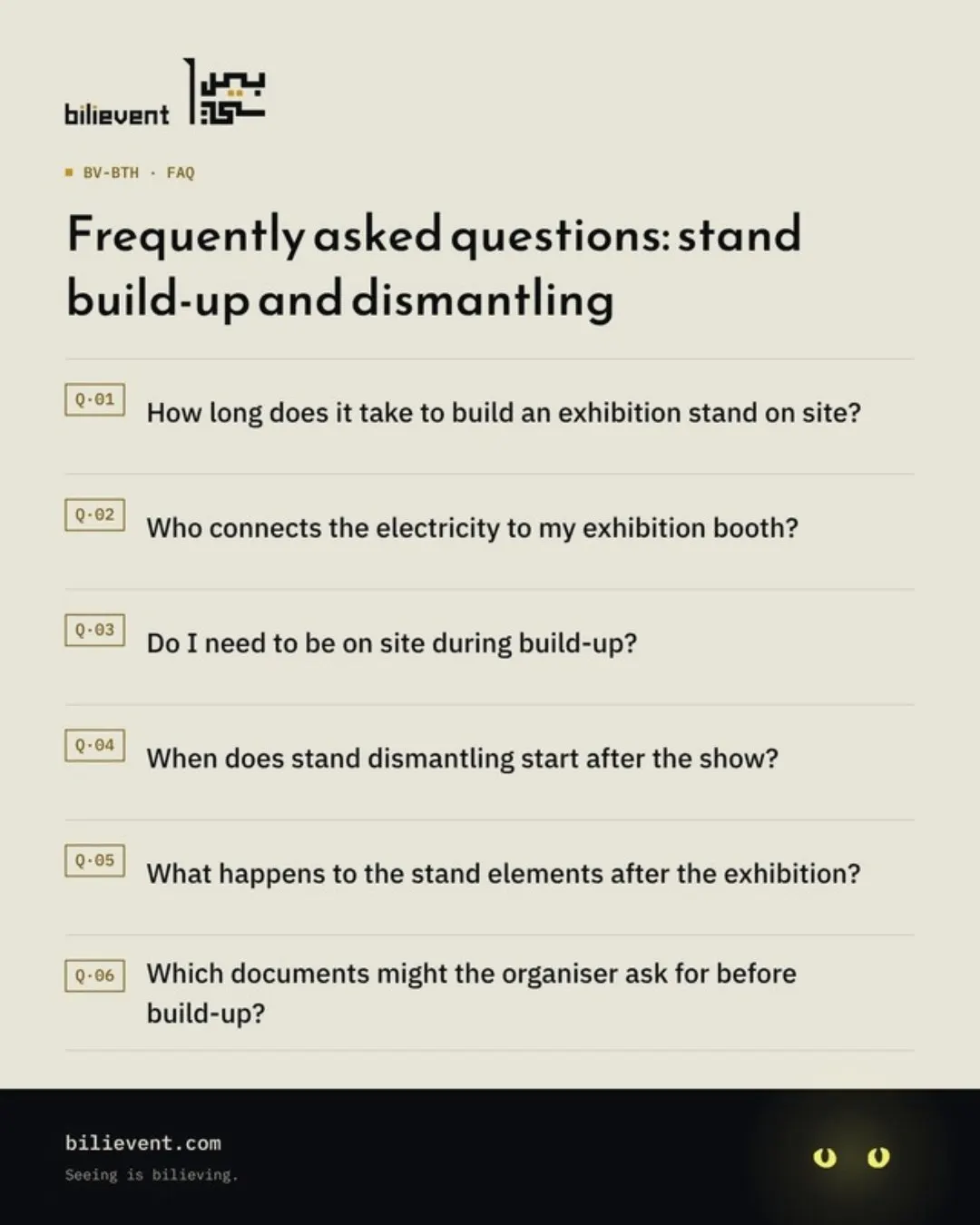
Frequently asked questions
How long does it take to build an exhibition stand on site?
It depends on the size and complexity of the design, how many custom-made elements it has, and the build-up days the organiser sets in the exhibitor manual. A shell scheme booth supplied by the organiser takes far less time than a custom stand on a space-only plot. Ask your builder for a schedule that spreads the work across the available build-up days and leaves time for a final check and cleaning.
Who connects the electricity to my exhibition booth?
At many venues the organiser’s official electrical contractor connects the main supply to your space, once you or your builder have ordered it by the deadline. The wiring inside the booth, including lighting, sockets and screens, is installed by the stand builder’s team. Read the services section of the exhibitor manual to see who is responsible and when the order must be placed.
Do I need to be on site during build-up?
Not necessarily all the time, but having one person from your company reachable throughout build-up prevents a lot of delay. That person makes small decisions on site, joins the final walk-round and signs off the stand before products go in. If nobody can attend, agree with your builder on photos and video at set stages and on one contact who replies quickly.
When does stand dismantling start after the show?
Dismantling normally starts after the official close of the last show day, and many organisers do not allow anything to be removed earlier. Take out valuable exhibits and devices first, then let the builder’s crew start. The organiser sets a final deadline for returning the space clean and may charge for waste left behind, so confirm that your quote includes breakdown and waste removal.
What happens to the stand elements after the exhibition?
That depends on your agreement with the builder. Elements designed for reuse, such as counters, display units, frames and lighting, can be taken down and stored for a later show, while graphics are usually replaced. Ask for an inventory with photos of each element’s condition, and ask what storage and transport to the next show will cost. bilievent offers storage and reuse of stand elements.
Which documents might the organiser ask for before build-up?
It varies by show, but organisers commonly ask for stand drawings with dimensions, heights and materials for approval, and registration of the stand contractor and its crew. Some also ask for a method statement, a risk assessment and an insurance certificate. Check the list and deadlines in the exhibitor manual and agree with your builder which documents it prepares and which need your signature.